Center for Democracy & Technology
Annual Reports for a National Technology Policy Nonprofit
Mission-driven organizations working on complex policy issues are a core part of KTD Creative’s work. Their publications have to be credible, beautifully designed, and accessible to everyone. This case study looks at our work with the Center for Democracy & Technology.
The Center for Democracy & Technology (CDT) is a Washington, DC-based nonpartisan nonprofit working at the intersection of technology, law, and public policy. Founded in 1994, CDT has been a trusted advocate for digital rights since the earliest days of the internet. It works to protect civil rights and civil liberties in the digital age, advocating for privacy, free expression, digital equity, and responsible innovation, and helping ensure that emerging technologies, including AI, serve people and strengthen democratic institutions.
The Challenge
Each year, CDT’s annual report brings together a full year of accomplishments, initiatives, research, and impact. The subject matter is complex: technology policy, digital governance, privacy, security, and online rights. The design has to make that substantial content clear and engaging for a broad audience, including funders, partners, policymakers, and the public.
The report also has to be accessible to everyone, including people who use screen readers and other assistive technology. For an organization dedicated to digital equity, an accessible annual report is not optional.
How did KTD approach it?
KTD Creative has designed CDT’s annual report for four consecutive years. CDT provides the content, and we bring it to life in print and in an accessible digital format. Each year we:
- Design the print report, using typography, photography, color, and carefully structured layouts to guide readers through CDT’s accomplishments and demonstrate its impact.
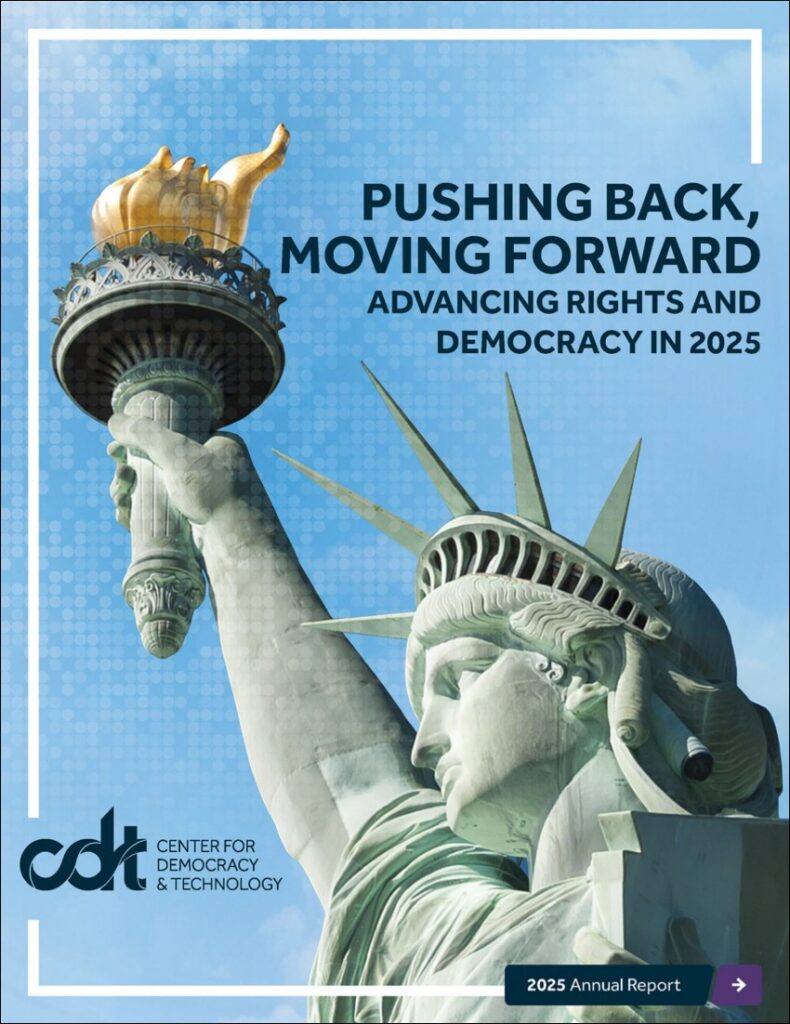
- Give each edition its own identity, from a report exploring technology and freedom in an AI future to the 2025 Annual Report, “Pushing Back, Moving Forward.”
- Produce a fully Section 508-compliant accessible PDF to accompany the print design, so the report can be read by the widest possible audience.
Why does 508 compliance matter?
Section 508 of the Rehabilitation Act requires federal agencies to make their electronic documents and information technology accessible to people with disabilities. Its standards have become the benchmark for accessible documents across government, nonprofits, and the organizations that work with them.
A 508-compliant PDF is built so that someone using a screen reader or other assistive technology can read and navigate the entire document. That means:
- A logical reading order, so content is read aloud in the right sequence.
- Tagged headings, lists, and paragraphs, so readers can move through the document by section.
- Alternative text that describes every meaningful photo, chart, and graphic.
- Accessible tables, with headers that are read correctly.
- Real, searchable text, readable color contrast, and a document title and language that assistive technology can identify.
A PDF exported straight from a design program almost never meets these standards on its own. Making a report truly accessible is specialized work. Our accessibility specialist, Kyle, remediates each CDT report so the accessible PDF meets 508 standards while matching the look of the print design.
The Result
CDT has a consistent, professional annual report that conveys sophisticated ideas clearly, establishes credibility, and is available to every reader, regardless of ability. Because we return to the project every year, each edition builds on what we have learned about CDT’s audiences and goals, which makes the process more efficient and the result stronger.
The partnership shows how KTD Creative combines thoughtful design with specialized accessibility expertise for national organizations tackling complex, consequential issues. See each year of this work in our portfolio:
- Services in This Project: Graphic Design, Event Design & Video · Nonprofit Marketing
- Related Case Studies: Affordable Homes & Communities · Farmworker Justice · National Academies of Sciences, Engineering, and Medicine
- Explore More: Our Full Portfolio · All Case Studies
Planning a similar project? Let’s talk.